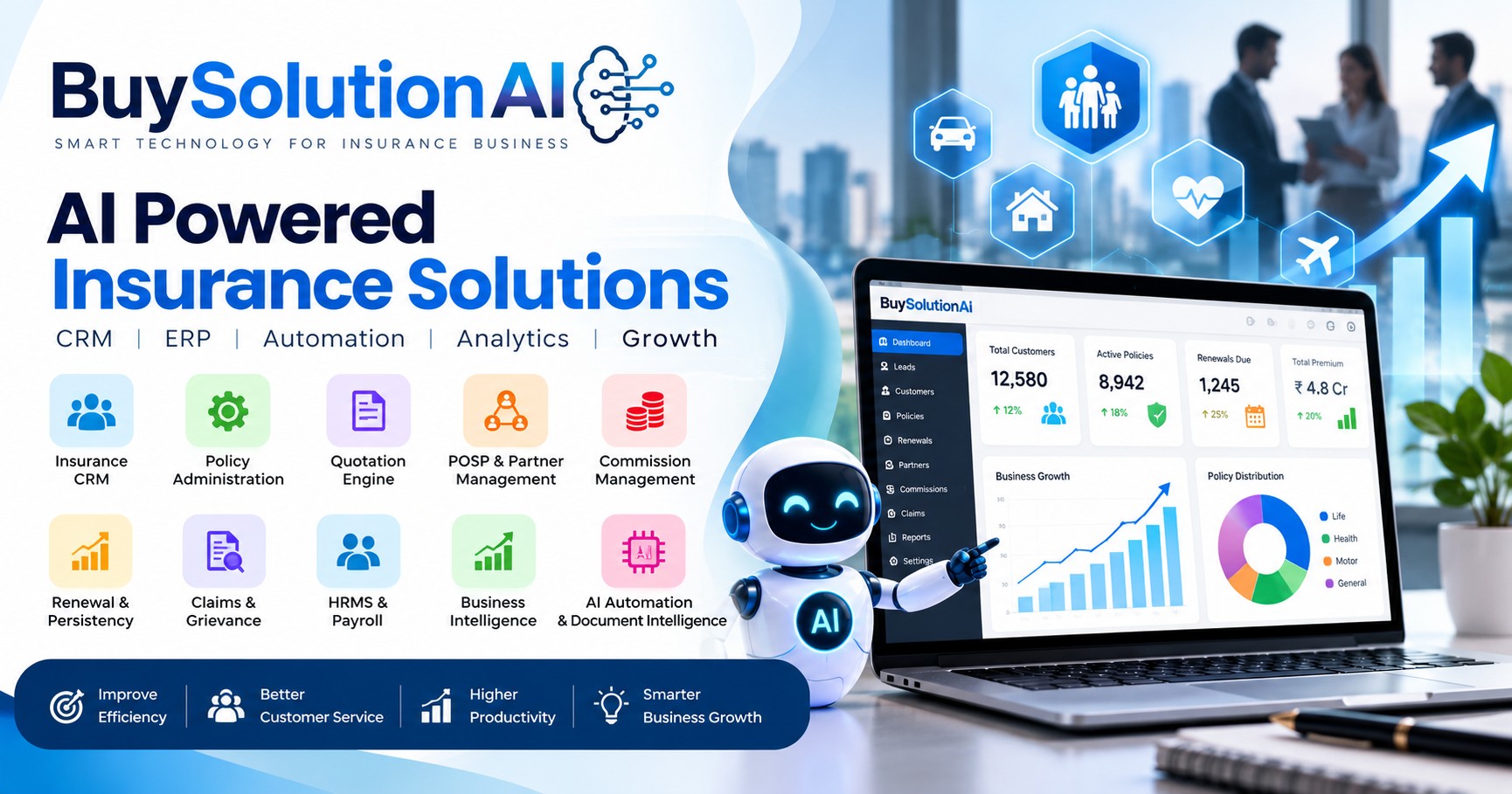

360-Degree Insurance CRM Software
360-Degree Insurance CRM Software helps insurance brokers, Insurance Marketing Firms (IMFs), POSP networks, agents and insurance distribution companies manage their complete business operations through one integrated digital platform. By connecting lead management, customer relationships, sales tracking, policy administration, renewal management, employee activities and business reporting, insuran
360-Degree Insurance CRM Software: Manage Your Entire Business with Minimum Manpower
360-Degree Insurance CRM Software helps insurance brokers, Insurance Marketing Firms (IMFs), POSP networks, agents and insurance distribution companies manage their complete business operations through one integrated digital platform. By connecting lead management, customer relationships, sales tracking, policy administration, renewal management, employee activities and business reporting, insurance organisations can reduce repetitive manual work and manage more business with fewer operational resources.
In today's competitive insurance industry, managing different activities through separate applications, spreadsheets and manual registers creates unnecessary complexity. A unified CRM solution brings important business information together, allowing management and employees to work through organised processes with improved visibility and control.
BuySolutionAI focuses on connected insurance software solutions designed to help insurance businesses simplify operations, automate workflows and build a scalable digital business environment.
What Is 360-Degree Insurance CRM Software?
360-Degree Insurance CRM Software is an integrated customer and business management platform that provides a comprehensive view of an insurance organisation's activities.
Unlike a basic CRM that primarily manages leads and customer details, a 360-degree insurance CRM can connect the entire customer lifecycle, from the first enquiry to policy issuance, servicing, renewal and ongoing relationship management.
A unified platform can bring together:
Lead generation and lead allocation.
Customer relationship management.
Sales pipeline management.
Insurance quotation tracking.
Policy and document management.
Renewal and persistency tracking.
Agent and POSP management.
Commission and business reporting.
Employee task management.
AI-assisted workflow automation.
The objective is to reduce disconnected processes and create a centralised operating environment for insurance businesses.
How Can Insurance CRM Software Reduce Manpower Requirements?
One of the biggest challenges for growing insurance businesses is the increasing amount of administrative work.
When every activity requires manual data entry, follow-up calls, report preparation and employee coordination, businesses may need additional staff simply to maintain their existing operations.
A properly configured CRM can automate repetitive activities and allow employees to concentrate on important customer and business decisions.
1. Automated Lead Management
A CRM can capture leads from websites, enquiry forms, campaigns and approved integrations.
Leads can be assigned to employees or distributors according to predefined business rules.
Automated notifications and follow-up tasks help ensure that new enquiries are not overlooked.
2. Centralised Customer Management
Instead of maintaining customer information in multiple spreadsheets, businesses can use one customer database.
Employees can access authorised customer information, communication history, policy details and follow-up activities from a centralised system.
This reduces repeated data entry and unnecessary information searches.
3. Automated Follow-Up Management
Manual follow-up management consumes considerable employee time.
CRM workflows can generate reminders, assign tasks and notify responsible employees about pending activities.
Managers can monitor follow-up status without repeatedly contacting every employee for updates.
4. Automated Renewal Management
Renewal activities can be connected with existing customer and policy records.
The CRM can identify upcoming expiry dates, organise renewal queues and schedule configurable reminder workflows.
This helps businesses manage existing customers without maintaining separate manual renewal registers.
5. Automatic MIS and Business Reporting
Preparing daily and monthly business reports manually can require considerable effort.
An integrated CRM can generate reports using available business records.
Management can monitor lead conversion, sales performance, pending activities, employee productivity and renewal progress through dashboards.
360-Degree CRM: Managing the Complete Insurance Customer Lifecycle
A modern insurance CRM should support every important stage of the customer journey.
Lead Generation and Enquiry Management
The system captures prospective customer enquiries and maintains their source, product interest and assigned employee.
Customer Relationship Management
Once an enquiry becomes a customer, the existing information can be organised into a customer profile with relevant communication and servicing history.
Quotation and Sales Pipeline
Employees can track quotation requests, proposal progress, customer responses and sales outcomes.
Policy Administration
Policy-related information can be organised for authorised users, helping employees access relevant customer and policy records.
Customer Servicing
Service requests, documentation requirements and customer communication can be recorded and assigned to responsible employees.
Renewal and Persistency
Upcoming policy renewals can be monitored through configurable schedules and assigned follow-up activities.
Business Performance
Management can review reports across products, branches, employees, agents and distributors.
How AI Technology Makes Insurance CRM More Intelligent
Artificial Intelligence can take insurance CRM software beyond traditional record management.
AI-assisted tools can help employees process information, understand customer interactions and reduce repetitive administrative activities.
Important AI applications include:
AI Lead Classification: Analyse available enquiry information and help categorise leads according to predefined business criteria.
AI Customer Communication: Prepare draft emails, follow-up messages and customer response summaries.
AI Document Processing: Use OCR and document intelligence to extract information from policy documents for employee verification.
AI Sales Assistance: Summarise customer interactions and help employees prepare for follow-up conversations.
Predictive Business Analytics: Analyse historical business information to identify trends and potential opportunities.
AI-Powered Reporting: Generate summaries of business performance and highlight important changes in available records.
Intelligent Task Management: Help employees organise pending activities and prioritise work.
AI recommendations should remain subject to employee review, appropriate data access and customer privacy requirements.
Important Features of a Complete Insurance CRM Platform
Insurance brokers and distribution organisations should consider the following capabilities when choosing CRM software:
Centralised lead and customer database.
Automated lead allocation.
Customer interaction history.
Sales pipeline tracking.
Quotation and proposal management.
Policy record management.
Renewal reminders and follow-ups.
POSP and agent management.
Commission tracking.
Employee productivity dashboards.
Automated MIS reporting.
AI-assisted business workflows.
Role-based access controls.
Document management.
Integration capabilities.
A platform should be configurable according to the organisation's actual operational requirements.
How Different Insurance Businesses Benefit from 360-Degree CRM
Insurance Brokers: Manage customer enquiries, quotations, policy records, servicing activities and renewal opportunities through connected workflows.
Insurance Marketing Firms: Coordinate customer information, distributors, employee responsibilities and business reporting.
POSP Networks: Organise distributor records, lead assignments, sales activities and performance reports.
Insurance Agents: Manage customer relationships, policy information and renewal follow-ups from a centralised system.
Insurance Agencies: Improve coordination between sales, servicing, operations and management teams.
Why Choose BuySolutionAI for Insurance CRM Software?
BuySolutionAI focuses on providing connected insurance technology solutions for insurance brokers, IMFs, POSP businesses and insurance distribution organisations.
The objective is to reduce fragmented software usage and help businesses manage important operational activities through an integrated technology ecosystem.
BuySolutionAI's software solution areas include:
Insurance CRM and Lead Management.
Policy Administration.
Renewal and Persistency Management.
POSP and Distributor Management.
Commission Management.
Employee and Business Reporting.
AI-Assisted Workflow Automation.
Businesses can explore BuySolutionAI Insurance CRM and Lead Management Software to understand its CRM-focused solutions.
They can also explore Insurance Policy Administration Software and Renewal and Persistency Management.
How to Calculate the Operational Value of CRM Automation
Businesses should evaluate CRM automation using measurable operational indicators rather than assuming that software automatically reduces staffing costs.
Useful measurements include:
Average time spent on manual lead allocation.
Number of follow-up activities automated.
Time required to prepare management reports.
Duplicate customer records reduced.
Number of policies managed per employee.
Average time required to locate customer information.
Pending activities per employee.
Customer enquiry response time.
For example, if a team spends several hours every week preparing manual sales reports, automated dashboards may reduce that repetitive workload.
The organisation can then redirect employee time towards customer servicing, sales development and business expansion.
The actual manpower savings will depend on process design, transaction volume, employee training and automation quality.
The Future of Insurance CRM: One Platform, More Business Efficiency
The future of insurance CRM is moving towards integrated platforms that combine customer management, artificial intelligence, automation and business intelligence.
Insurance businesses increasingly need technology that can support multiple departments without creating additional administrative complexity.
A connected CRM ecosystem can help organisations reduce duplicated work, improve data visibility and manage larger customer portfolios through standardised processes.
The goal is not simply to reduce the number of employees. It is to enable existing teams to perform more valuable work with better information and less repetitive administration.
Conclusion
360-Degree Insurance CRM Software provides a practical foundation for insurance businesses that want to connect their complete customer lifecycle and improve operational efficiency.
By integrating lead management, customer servicing, policy records, renewals, distributor management, reporting and AI-assisted automation, insurance organisations can reduce fragmented processes and manage their business through a unified platform.
For insurance brokers, IMFs, POSP networks and insurance agencies, the combination of intelligent automation and centralised CRM management can support business growth while reducing dependence on repetitive manual activities.
BuySolutionAI aims to support this transformation through connected insurance software solutions designed for modern insurance distribution businesses.